
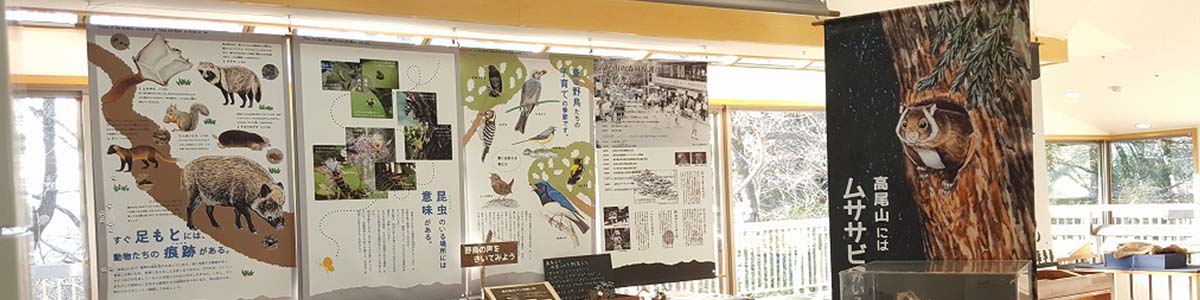
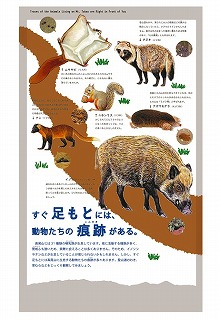
 There are 31 species of mammals living on Mt. Takao. Many are nocturnal and are very cautious so it is difficult to find them. It may be hard to believe there are wild boars and Japanese martens (Martes melampus) out there but they are there. Look down by your feet and you will see traces of the animals found on Mt. Takao.
Observe closely along the sides of mountain climbing trails and tufts of grass.
Japanese giant flying squirrel (Petaurista leucogenys) (Sciuridae)
A hold about the size of an adult fist on a thick tree trunk may be the nest for a Japanese giant flying squirrel.
See if you can find some small round droppings around the tree roots.
Japanese squirrel (Sciurus lis) (Sciuridae)
Chewed pine cones that look like shrimp tempura may have been left behind after a squirrel feasted on them.
Japanese marten (Martes melampus) (Mustelidae)
Droppings about the size of an adult pinky found on top of stone walls or other noticeable places may be from a Japanese marten. See if you can find vegetation or insect wings in them.
Small Japanese Mole (Mogera imaizumii) (Talpidae)
If you see mounds of dirt on the ground it may be sign that there are mole tunnels underneath. The dirt mounds are called molehills.
Japanese raccoon dog (Nyctereutes procyonoides viverrinus) (Canidae)
If you see droppings the size of an adult thumb along the sides of mountain climbing trails or tufts of grass, which could be the outhouse for a Japanese raccoon dog. Japanese raccoon dogs collect their droppings in the same spot and these spots are called latrines.
Wild boar (Sus scrofa) (Suidae)
A dug up hole about the size of a manhole on the side of a path
could be traces of a wild boar searching for food.
They use their nose to dig dirt. Look for boar hoof prints.
바로 발 밑에는 다카오산에 서식하는 동물들의 흔적이 있어
다카오산에는 31종의 포유류가 서식하고 있습니다. 밤에 활동하는 종류가 많고 경계심도 강해 실제로 만날 수 있는 것은 많지 않습니다. 그래서 멧돼지와 담비 등이 서식하는 것이 믿어지지 않을지도 모릅니다. 하지만 바로 발 밑에는 다카오산에 서식하는 동물들의 흔적이 많이 있습니다.
등산로 옆, 풀숲 등을 차분히 관찰해 봅시다.
날다람쥐 (Petaurista leucogenys) (다람쥐과) (Sciuridae)
굵은 나무 줄기에 있는 어른 주먹만한 크기의 구멍은 날다람쥐 둥지일지도 모릅니다.
나무 밑둥에 작고 둥근 배설물이 떨어져 있지 않습니까?
일본 다람쥐 (Sciurus lis) (다람쥐과 (Sciuridae))
갉아 먹어서 새우튀김처럼 된 솔방울은 다람쥐가 먹고 남은 흔적일지도 모릅니다.
산달 (Martes melampus) (족제비과 (Mustelidae))
돌담 위 등, 눈에 띄는 곳에 있는 어른의 새끼 손가락만한 크기의 배설물은 산달의 것일지도 모릅니다. 식물의 씨앗이나 곤충의 날개가 들어 있지 않습니까?
아즈마 두더지 (Mogera imaizumii) (두더지과 (Talpidae))
지면에 흙더미가 몇 군데나 있으면 땅 속에 두더지의 터널이 있을지도 모릅니다. 흙더미는 “두더지 무덤”이라고 불립니다.
일본 너구리 (Nyctereutes procyonoides viverrinus) (개과 (Canidae))
등산로 옆이나 풀숲에 어른의 엄지 손가락 만한 배설물이 쌓여 있으면 너구리의 화장실일지도 모릅니다. 굴 이외의 정해진 장소에 배설물을 모으는 성질이 있어 “타메훈죠(배설물 모으는 곳)”라고 불립니다.
멧돼지 (Sus scrofa) (멧돼지과 (Suidae))
길 옆에 있는 맨홀 정도의 판 흔적은
멧돼지가 음식을 찾은 흔적일지도 모릅니다.
코로 땅을 파헤칩니다. 발굽 자국도 찾아봅시다.
就在脚边,有着生活在高尾山的动物留下的痕迹
在高尾山,栖息着31种哺乳类动物。这些哺乳类动物多在夜间活动,且警惕心很强,因此很难遇到。因此,可能很难让人相信这里还生活着野猪(Sus scrofa)和日本貂(Martes melampus)等。不过,您的脚边就有很多生活在高尾山的动物留下的痕迹。
让我们来认真观察登山路两旁和草丛这些地方吧。
白颊鼯鼠(Petaurista leucogenys)(松鼠科(Sciuridae))
在粗壮树干上成人拳头大小的洞,可能就是白颊鼯鼠的窝。
看看在树根处有没有小颗的圆形粪便?
日本松鼠(Sciurus lis)(松鼠科(Sciuridae))
像咬过的炸虾天妇罗一样的松果,可能就是日本松鼠吃剩的。
日本貂(Martes melampus)(鼬科(Mustelidae))
在石墙等明显的地方,那些成人小指大小的粪便可能就是日本貂留下的。看看里面有没有植物种子或是昆虫翅膀?
东日本鼹鼠(Mogera imaizumii)(鼹科(Talpidae))
如果地面上有几处小土堆,地下就有可能生活着东日本鼹鼠。土堆被称作“鼹鼠洞”。
日本貉(Nyctereutes procyonoides viverrinus)(犬科(Canidae))
在登山路两旁、草丛中,如果堆着成人拇指大小的粪便,那可能就是日本貉的厕所。日本貉有在巢穴之外固定场所堆积粪便的习性,也被称为“貉粪堆”。
野猪(Sus scrofa)(野猪科(Suidae))
道路两旁井盖大小的刨土痕迹,
可能就是野猪在找食时留下的。
野猪用鼻子来拱土。让我们来找找有没有蹄印。